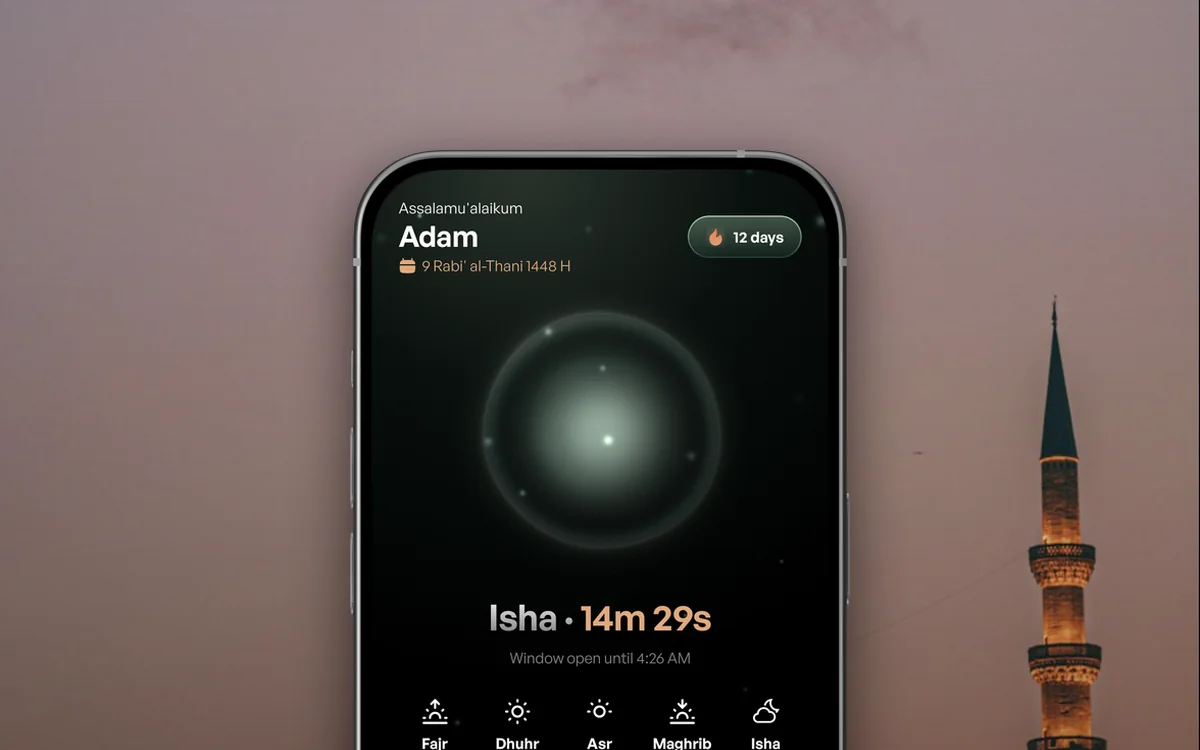
 Ishra
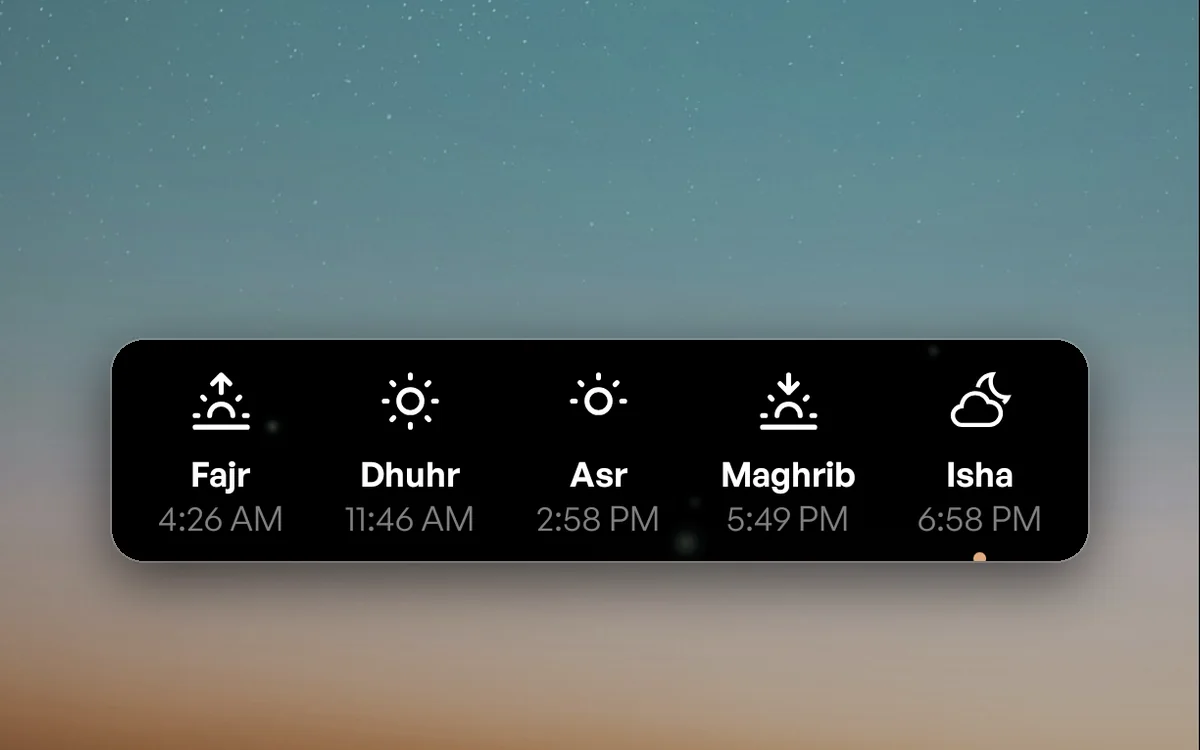
Open two prayer apps and the calendar on your masjid's wall, and you can easily find three different times for the same Maghrib. It is unsettling, especially when an app is about to pause your phone on the strength of that number.
Most of the time, nobody is wrong. Each one is answering a slightly different question. Here are the five things that make the difference, roughly from largest to smallest.
1. The calculation method
Dhuhr and Maghrib are tied to clear events: the sun crossing its highest point, and the sun disappearing below the horizon. Fajr and Isha are not. They depend on how dark the sky has to be, and that is expressed as an angle of the sun below the horizon.
Different authorities chose different angles. Kemenag in Indonesia uses 20° for Fajr and 18° for Isha. The Muslim World League uses 18° and 17°. ISNA in North America uses 15° for both. Umm al-Qura sets Isha at a fixed 90 minutes after Maghrib. Pick a different method and Fajr can move by twenty minutes or more.
Asr has its own split. In the majority view it begins when an object's shadow equals its length (plus its shadow at noon); in the Hanafi view, when the shadow reaches twice the length. That alone can move Asr by close to an hour.
What to do: choose the method your local authority uses, and the madhab you follow for Asr. Ishra asks for both during setup, and you can change them in Settings.
2. Ihtiyati, the safety margin
Some authorities do not publish the raw astronomical time. Kemenag and JAKIM add a precautionary margin, ihtiyati, of a couple of minutes, so that no one prays a moment too early. An app that calculates the pure astronomy will be right about the sun and still early against every jadwal in the country.
In Ishra: on Android and iPhone, the Kemenag and JAKIM methods add the same safety minutes their published schedules do.
3. Your height above the sea
From higher ground you can see further over the curve of the earth, so the sun sets later for you than for someone at sea level, and rises earlier. In a city like Bandung, around 700 metres up, that is worth roughly four minutes of Maghrib, every single day.
In Ishra for Android: every city in the catalogue carries its elevation, and a GPS fix uses your own. Only Maghrib and sunrise move, the way Kemenag's own tables do it.
4. Your exact point on the map
A city in a prayer app is a single dot, usually its centre. Jakarta, or any large region, spans enough longitude that the east and west edges see the sun at slightly different moments. If you picked your city rather than your location, you may be a minute or two away from your own sky.
In Ishra for Android: Settings can use your phone's exact coordinates, and shows which point and height the times are worked out for.
5. Your masjid's own convention
After all of that, some masjids still round, add a few minutes before the iqamah, or follow a calendar printed years ago. That is their call to make, and a good one to respect.
In Ishra for Android: you can correct any single prayer by up to 30 minutes either way, so your phone matches the adhan you actually hear.
The short version
Pick your authority's method and your madhab, let Ishra use your real location, and fine-tune the rest by hand. And where an app, any app, differs from your local masjid or your scholar, follow them. A prayer app is a helper, never the authority.